A Sleeping Giant Awakens: How a New Law Makes Millions of Americans, Especially in New Hampshire, Instant Canadian Citizens
A landmark change in Canadian law means millions of Americans, particularly in New Hampshire, may now be dual citizens. Find out if your ancestry qualifies you for a Canadian passport.

Free Immigration Assessment
Complete our smart assessment form to check your eligibility for over 80+ Canadian immigration programs.
A Paradigm Shift in Canadian Citizenship Law
In a move with profound and far-reaching implications, the Canadian government has fundamentally altered its approach to citizenship by descent, effectively awakening a dormant connection for millions of Americans with roots in Canada. A landmark amendment to Canada’s Citizenship Act, which took effect on December 15, 2025, has eliminated the long-standing generational limit for inheriting citizenship. This single legislative change means that for anyone born before that date, having even one Canadian ancestor—no matter how many generations removed—is now legally recognized as a Canadian citizen.
This is not a new pathway to apply for citizenship; it is a legal recognition of a status that, according to Canadian law, has existed all along. For countless Americans, particularly those in New England, this news transforms a point of ancestral pride into a tangible legal reality. The focus of this monumental shift is sharpest in states like New Hampshire, where deep historical ties to Canada mean a significant portion of the population has unknowingly held a claim to Canadian identity.
New Hampshire: Ground Zero for a Citizenship Revelation
While this policy change affects Americans nationwide, its impact on the Granite State is nothing short of extraordinary. Due to a unique history of mass migration, it is estimated that the share of New Hampshire residents with Canadian ancestry may sit at or above 30%. This suggests that more than one in four people in the state could now be eligible to claim their Canadian citizenship and obtain a passport.
This figure starkly contrasts with U.S. Census Bureau data, which shows New Hampshire has the highest level of self-reported Canadian ancestry at 8.06%. While this is the highest in the nation, experts and historical data suggest this is merely the tip of the iceberg. The discrepancy lies in the generations that have passed since the great wave of migration, with many families identifying simply as American today, unaware of their direct, unbroken lineage to a Canadian ancestor.

The Great Migration: How Quebecois Roots Shaped New England
To understand the scale of this phenomenon, one must look back to the period between 1840 and 1930. During these 90 years, economic hardship and limited opportunities in rural Quebec drove approximately 900,000 French Canadians south into the burgeoning industrial towns of New England. They came seeking work in the textile mills and factories, forming vibrant, close-knit communities that preserved their language and culture.
New Hampshire was a primary destination for this diaspora. The numbers are telling. A former executive director of the Laconia Historical and Museum Society estimated that the French Canadian population in New Hampshire swelled from a mere 1,780 in 1860 to a staggering 101,324 by 1930. In the mill city of Manchester, the impact was even more concentrated. According to genealogist Kim Kujawski, by 1910, French-Canadians numbered 23,000 in Manchester alone, accounting for a remarkable 38% of the city’s entire population. The community was so prevalent and distinct that New Hampshire mill workers were even credited with developing their own unique dialect of French.
Today, the descendants of these workers are scattered across the state and the country, many of them four or more generations removed from the ancestor who first crossed the border. Yet, under the new law, that historical link is all that is required.
From Ancestry to Passport: A Practical Guide for Eligible Americans
For the potentially hundreds of thousands of newly-recognized Canadian citizens in New Hampshire and beyond, the question becomes practical: how does one formalize this status? The process involves two main stages: proving your citizenship and then applying for a passport. It is a journey that begins with genealogical detective work.
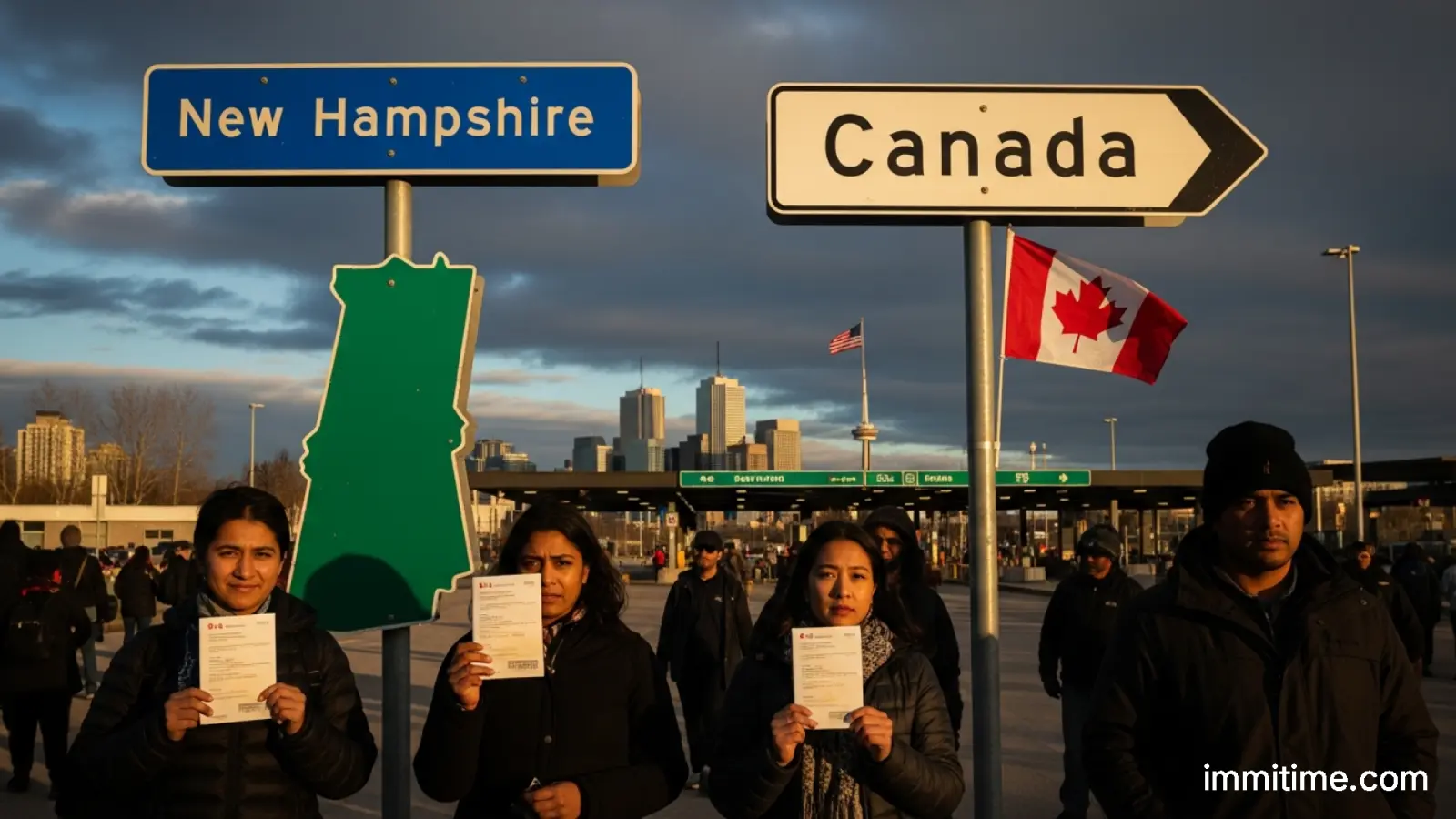
Step 1: Unearthing Your Canadian Lineage
The most significant hurdle for most applicants is collecting the necessary documentation to prove an uninterrupted chain of descent from a Canadian ancestor. This requires a paper trail connecting you to your parent, your parent to your grandparent, and so on, all the way back to the family member who was born or naturalized in Canada.
Essential documents include:
- Birth certificates for each generation
- Marriage certificates to prove connections
- Baptismal records, which can often substitute for or supplement civil records
For those tracing French-Canadian ancestry, experts such as the former executive director of the Laconia Historical and Museum Society point to the meticulous records kept by the Roman Catholic Church as an invaluable resource. Furthermore, Quebec’s national archive, the Bibliothèque et Archives nationales du Québec (BAnQ), holds a vast collection of civil records more than a century old. However, the immense interest generated by the new law has flooded the BAnQ with requests. Because the archive prioritizes requests from local residents, many Americans are finding the process slow and challenging. This has led some to retain Quebec-based immigration lawyers or licensed immigration consultants who can more efficiently navigate the system and retrieve certified documents on their behalf.
Step 2: Applying for a Proof of Canadian Citizenship Certificate
Once you have assembled your documentary evidence, the next step is to submit an application to Immigration, Refugees and Citizenship Canada (IRCC) for a Proof of Canadian Citizenship Certificate. This is the official document that legally confirms your status. For most Americans, this will require submitting a paper application package containing the forms and all supporting genealogical documents.
Patience is key. As of the time of writing, IRCC estimates the processing time for proof of citizenship applications at 10 months. After a successful review, you will be issued the certificate, which is the foundational document for all your rights and privileges as a Canadian citizen.
Step 3: Securing Your Canadian Passport
With your proof of citizenship certificate in hand, the final step is straightforward. You can now apply for a Canadian passport. This process is significantly faster. Current processing times for Canadian passports are between 10 and 20 business days. The Canadian government is so confident in its service standard that it even offers a 30-day money-back guarantee on the processing time.
The Canadian passport is one of the most powerful travel documents in the world, and for eligible New Hampshire residents, it represents the culmination of a journey back through their family's history.
Expert Analysis: The Broader Implications of a Redefined Citizenry
As an immigration analyst, it is difficult to overstate the significance of this legislative change. It represents a philosophical shift in how Canada views its diaspora. By removing the generational cutoff, Canada is embracing a more expansive and inclusive definition of nationhood, one tied to history and heritage rather than just recent residency.
For individuals, the benefits are immense. Dual U.S.-Canadian citizenship grants the right to live, work, and study in Canada without restriction. It opens up access to Canada's education and healthcare systems, provides a second passport for easier international travel, and offers a safe harbor and expanded opportunities for future generations. For a New Hampshire family, it could mean a child choosing to attend a Canadian university at domestic tuition rates or an adult deciding to pursue a career opportunity in Toronto or Vancouver.
This will also have demographic and economic consequences for Canada. It could trigger a wave of passport applications, increased travel, and potentially a slow but steady stream of highly skilled and educated American-Canadians choosing to relocate, invest, or reconnect with their ancestral homeland. The story of the Quebecois migration to New England's mills has come full circle, with the descendants of those workers now being welcomed back into the Canadian family, not as immigrants, but as citizens in their own right.
Frequently Asked Questions
Am I eligible for Canadian citizenship if my Canadian ancestor is many generations back?
Yes. Under the law change that took effect on December 15, 2025, anyone born before that date who can prove their lineage to a Canadian ancestor is legally recognized as a citizen, with no generational limit.
What is the first step I need to take to claim my Canadian citizenship?
The first step is to gather documents proving your continuous line of descent from a Canadian ancestor. You then use these documents to apply for a 'proof of Canadian citizenship certificate' from the Canadian government.
How long does the entire process to get a Canadian passport take?
The process has two main parts. Currently, applying for the proof of citizenship certificate takes about 10 months. Once you receive the certificate, applying for a Canadian passport takes an additional 10 to 20 business days.
Why is New Hampshire particularly affected by this new Canadian law?
Between 1840 and 1930, a huge number of French Canadians migrated to New Hampshire to work in mills. Because of this mass migration, it's estimated that 30% or more of the state's population may have Canadian ancestry, making them eligible under the new law.
Free Immigration Assessment
Complete our smart assessment form to check your eligibility for over 80+ Canadian immigration programs.
Last Updated: