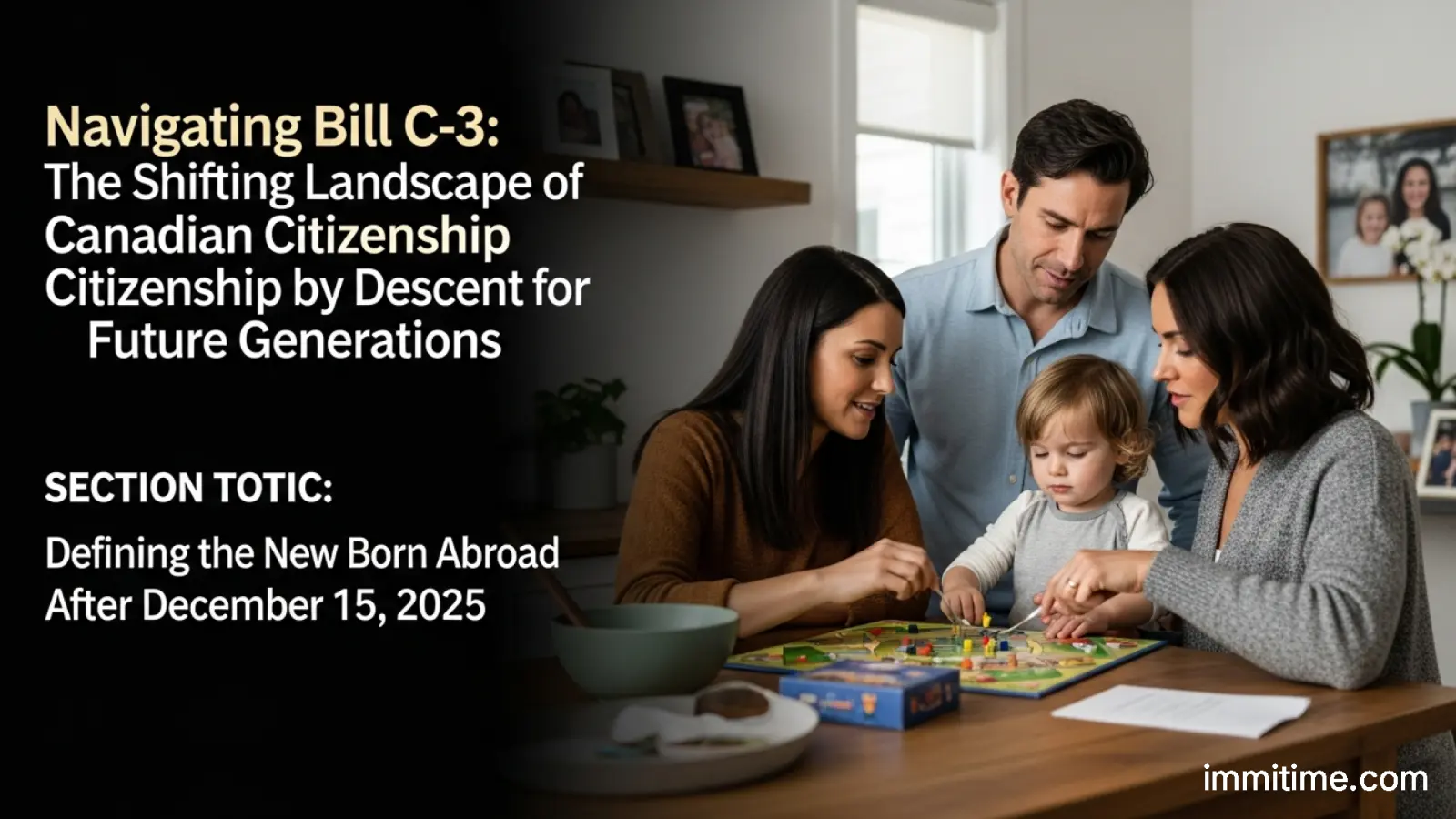
Navigating Bill C-3: The Shifting Landscape of Canadian Citizenship by Descent for Future Generations
Bill C-3 has restored Canadian citizenship for many but introduces a 'substantial connection test' for children born abroad after December 15, 2025. Expert analysis reveals critical implications for multi-generational citizenship and offers actionable advice, including the strategic use of birthright citizenship in Canada.

Understanding Bill C-3: A Dual Impact on Canadian Citizenship
Canada's citizenship laws are a dynamic and often complex domain, particularly for those living abroad or with ancestral ties to the nation. A pivotal legislative amendment, Bill C-3, enacted by Immigration, Refugees and Citizenship Canada (IRCC), has introduced significant changes that both restore and restrict Canadian citizenship by descent. While it has been lauded for reinstating citizenship to many individuals who previously lost it, the same legislation has quietly implemented a new provision that could profoundly impact the citizenship status of future generations born outside Canada.
As an expert immigration journalist and policy analyst, I frequently encounter questions regarding the nuances of Canadian citizenship. Bill C-3, effective December 15, 2025, stipulates that individuals born before this date who can demonstrate an unbroken line of descent to a Canadian ancestor are eligible to reclaim their Canadian citizenship. This restoration is a welcome development for many, offering a pathway to reconnect with their heritage without stringent language tests or immediate residency requirements. However, the legislation simultaneously introduces a critical new limitation for children born abroad after this specific cut-off date.
This article delves into the intricacies of Bill C-3, exploring its implications for current and future Canadian citizens, outlining the 'substantial connection test,' and providing actionable advice for families navigating these evolving regulations. Understanding these provisions is paramount for anyone with Canadian lineage or plans to start a family abroad.
The 'Substantial Connection Test': A New Hurdle for Citizenship by Descent
Defining the New Restriction: Born Abroad After December 15, 2025
The core of the new restriction lies in what IRCC refers to as the 'substantial connection test.' For children born or adopted abroad on or after December 15, 2025, the automatic transmission of Canadian citizenship from a parent who was also born abroad is no longer guaranteed. Instead, the Canadian parent must demonstrate a significant physical presence in Canada prior to the child's birth or adoption. Specifically, this parent must have accumulated at least 1,095 cumulative days — approximately three years — of physical presence in Canada.
This requirement signifies a fundamental shift. Previously, citizenship by descent could generally pass down one generation born abroad without such a residency stipulation. The new rule aims to ensure that Canadian parents born outside the country maintain a tangible link to Canada before they can transmit citizenship to their children born abroad. The days do not need to be consecutive; they can be accumulated at any point in the parent's life before the child's birth. However, if a Canadian parent born abroad has never resided in Canada for an extended period, meeting this test becomes a significant challenge.

Illustrative Case Study: Marie, Luc, and Camille
To grasp the practical implications of this rule, consider the hypothetical case of Marie, a 38-year-old pediatric nurse residing in Boston. Marie's grandmother emigrated from Quebec to Massachusetts in the 1950s. Under Bill C-3, Marie is eligible for Canadian citizenship because she was born before December 15, 2025, and can trace an unbroken line of descent to her Canadian ancestor. She needs only to apply for proof of Canadian citizenship.
Marie has two children: Luc, born in 2023, and Camille, born in 2027. Luc, like his mother, is automatically Canadian. He was born before December 15, 2025, to a Canadian citizen parent (Marie). The 'substantial connection test' does not apply to him. However, Camille, born in 2027, faces a different reality. Since she was born after December 15, 2025, and her mother, Marie (who was born abroad), has never lived in Canada for the required 1,095 days, Camille is not automatically a Canadian citizen. This scenario starkly illustrates how two children from the same family can have vastly different citizenship outcomes due to the new legislation.
The Multigenerational Impact: Breaking the Chain of Citizenship
The ramifications of the 'substantial connection test' extend far beyond the immediate generation. This provision is a permanent feature of Canadian law, applying to every future child born abroad to a Canadian parent who was also born abroad. Without intervention, it creates a scenario where citizenship by descent can cease to transmit after the current generation.
Consider Luc, who is automatically Canadian due to his birth in 2023. If Luc grows up in Boston and never establishes the required 1,095 days of physical presence in Canada, his own children, when born abroad, will face the same 'substantial connection test.' If he hasn't met the residency requirement by then, his children will not inherit Canadian citizenship. Furthermore, Camille, who is not Canadian herself, has no citizenship to pass on to her future children through descent. This means her children would have no direct pathway to a Canadian passport through their maternal lineage.
In essence, the door that Bill C-3 opened for individuals born before December 15, 2025, begins to narrow significantly for each subsequent generation born outside Canada unless a parent in that chain spends a cumulative three years living within Canada. This policy underscores Canada's intent to foster a more direct and demonstrable link to the country for individuals seeking to pass on their citizenship.
A Practical Workaround: The Power of Jus Soli
Giving Birth in Canada: A Direct Path to Citizenship
Despite the complexities introduced by the 'substantial connection test,' a straightforward workaround exists for newly recognized Canadians planning to expand their families: giving birth in Canada. Canada operates under the principle of jus soli, or birthright citizenship, which grants automatic Canadian citizenship to anyone born on Canadian soil. This applies irrespective of the parents' immigration status, with the primary exception being children born to accredited foreign diplomats.
For individuals like Marie, this provision offers a crucial alternative. Had Camille been born in Canada instead of Boston, the 'substantial connection test' would have been entirely irrelevant. Camille would have been Canadian by birth, not through descent from her mother. The question of Marie's 1,095-day residency in Canada would not have applied. As a Canadian citizen, Marie possesses the legal right to enter and reside in Canada, making this option a viable and impactful choice for ensuring her child's Canadian citizenship from day one.
Dual Citizenship Considerations for U.S. Parents
For Canadian parents who are also U.S. citizens, or whose children may also acquire U.S. citizenship, giving birth in Canada typically has no adverse impact on their American citizenship or their child's potential U.S. citizenship. A U.S. citizen does not forfeit their citizenship by having a child in another country. Furthermore, a child born in Canada to an American parent generally acquires U.S. citizenship by descent, provided the parent meets the U.S. physical presence requirements—a threshold that most American-raised adults readily clear.
This means a child born in Canada to a newly recognized Canadian parent from the U.S. would likely hold dual citizenship from birth: Canadian through jus soli and American through descent. This offers significant flexibility and opportunity for families navigating international ties.
Important Distinctions and Unanswered Questions
Adoption vs. Birth: A Critical Difference
It is crucial to note that the jus soli workaround applies specifically to birth, not to international adoption. A child adopted from abroad after December 15, 2025, remains subject to the 'substantial connection test.' This is because jus soli pertains to the place of birth, not the location where an adoption is finalized. Families contemplating international adoption should seek specialized guidance to understand how the 'substantial connection test' will apply to their unique circumstances.
Uncertainty Regarding Documentation and Verification
As of now, IRCC has not published comprehensive operational guidance detailing how the 1,095-day residency requirement will be documented or verified. While testimony before the Senate on November 17, 2025, confirmed that the days are cumulative and do not need to be consecutive, questions persist regarding the specific types of evidence IRCC will accept. For instance, whether categories of time in Canada, such as childhood visits, will count towards the requirement remains unclear. Until official guidance is released, applicants are strongly advised to meticulously document all periods of physical presence in Canada.
Actionable Advice for Affected Individuals
Understanding the nuances of the 'substantial connection test' and the available workarounds is vital for anyone impacted by Bill C-3. Here are key steps and considerations:
- Verify Your Eligibility: If you believe you qualify for Canadian citizenship under Bill C-3, initiate the application process for proof of citizenship promptly. Ensure you can trace an unbroken line of descent to a Canadian ancestor.
- Assess Family Impact: For newly recognized Canadians, especially those planning to have children or those with children born after December 15, 2025, carefully evaluate how the 'substantial connection test' applies to your family.
- Document Time in Canada: If you are a Canadian parent born abroad and anticipate your children being born after December 15, 2025, start meticulously documenting any and all periods of physical presence in Canada. This could include old passports with entry/exit stamps, school records, employment records, rental agreements, and other proof of residency.
- Consider Birth in Canada: For those who can, giving birth on Canadian soil is a definitive way to ensure your child acquires Canadian citizenship automatically, bypassing the 'substantial connection test.'
- Seek Expert Immigration Counsel: Given the complexities and the evolving nature of IRCC's operational guidance, consulting with immigration lawyers specializing in citizenship by descent is highly recommended. They can provide tailored advice, help navigate the application process, and offer clarity on documentation requirements.
The changes introduced by Bill C-3 represent a significant evolution in Canadian citizenship law. While aiming to restore citizenship to many, it simultaneously tightens the criteria for future generations born abroad. Proactive understanding and strategic planning are essential for ensuring that your family's Canadian heritage remains unbroken.
Frequently Asked Questions
What is the 'substantial connection test' under Bill C-3?
The 'substantial connection test' requires a Canadian parent, who was also born abroad, to have spent at least 1,095 cumulative days (three years) physically present in Canada before their child, born abroad after December 15, 2025, can automatically inherit Canadian citizenship. This test ensures a demonstrable link to Canada.
Does Bill C-3 affect all children born to Canadian parents abroad?
No, it specifically affects children born or adopted abroad after December 15, 2025, whose Canadian parent was also born outside Canada. Children born before this date, even if born abroad to a Canadian parent born abroad, are generally automatically Canadian.
Is there a way for a child born abroad after December 15, 2025, to still get Canadian citizenship if their parent hasn't met the 1,095-day requirement?
Yes, a primary workaround is for the child to be born on Canadian soil. Under Canada's <em>jus soli</em> principle, anyone born in Canada automatically acquires Canadian citizenship, regardless of their parents' immigration status or residency history (with exceptions for diplomats).
How does Bill C-3 impact international adoptions?
The 'substantial connection test' still applies to children adopted from abroad after December 15, 2025. The <em>jus soli</em> workaround for birth in Canada does not apply to adoptions, as it concerns the place of birth, not the place of adoption.
What evidence does IRCC accept for the 1,095-day residency requirement?
IRCC has not yet published full operational guidance on documentation. However, it's advised to thoroughly document all periods of physical presence in Canada, such as through passport stamps, school records, employment records, or rental agreements, as the days are cumulative and need not be consecutive.
Last Updated: