Quebec's Family Reunification Boost: New Open Work Permit Pathways for Spouses of Skilled Workers
IRCC announced on June 5, 2026, an expansion to a temporary measure for Quebec, allowing spouses and common-law partners of eligible temporary foreign workers to apply for an open work permit, fostering family unity and addressing labour gaps. This pathway is open until the end of 2026.

Free Immigration Assessment
Complete our smart assessment form to check your eligibility for over 80+ Canadian immigration programs.
IRCC Expands Support for Quebec Workers: A Deep Dive into Open Work Permits for Spouses
Ottawa’s recent announcement on June 5, 2026, marks a significant development for temporary foreign workers and their families contributing to Quebec’s economy. Immigration, Refugees and Citizenship Canada (IRCC) has expanded a crucial temporary measure, initially introduced on March 13, 2026, designed to support Quebec workers and their employers. This latest enhancement directly addresses family unity and aims to bolster the province’s workforce by allowing spouses and common-law partners of eligible temporary foreign workers to secure open work permits.
As an expert in Canadian immigration policy, I view this expansion as a pragmatic step by IRCC to harmonize family and economic objectives within the unique framework of Quebec’s immigration system. It reflects a nuanced understanding of the challenges faced by temporary residents striving for permanent residence, particularly the critical need to keep families together during this often-complex transition.
Understanding the Expanded Temporary Measure: Key Eligibility and Scope
The core of this June 5, 2026, expansion lies in its direct benefit to the families of temporary foreign workers who are already on a pathway to permanent residence in Quebec. Specifically, it enables the spouses or common-law partners of principal applicants to obtain an open work permit, thereby granting them greater flexibility and the ability to contribute economically to their new community.
To qualify for this open work permit, the spouse or common-law partner must meet several specific criteria, which are critical for potential applicants to understand:
- Principal Applicant Eligibility: The primary temporary foreign worker must first be found eligible under the public policy announced on March 13, 2026. While the specifics of this initial eligibility are not detailed in the June 5, 2026, announcement, it is a foundational requirement for the spouse or common-law partner’s application. Applicants should ensure the principal worker has met all conditions of this underlying public policy.
- Valid Temporary Resident Status: The spouse or common-law partner must possess valid temporary resident status in Canada at the time of their application. Crucially, the policy also extends this eligibility to individuals whose temporary resident status may have expired within the last 90 days. This provision offers a valuable grace period, recognizing that maintaining continuous status can sometimes be challenging amidst complex immigration processes.
- Inclusion in Quebec’s Permanent Selection Application: A vital requirement is that the spouse or common-law partner must be explicitly named on the principal applicant’s permanent selection application, known as the Demande de sélection permanente. This application is a cornerstone of Quebec’s unique immigration system, specifically for the Programme de sélection des travailleurs qualifiés (Quebec’s Skilled Worker Selection Program). This condition underscores the measure’s direct link to the provincial pathway to permanent residence.
It is imperative for all interested parties to note that this measure is explicitly temporary, remaining open only until the end of 2026. This finite timeframe necessitates prompt action from eligible families to take advantage of this opportunity.
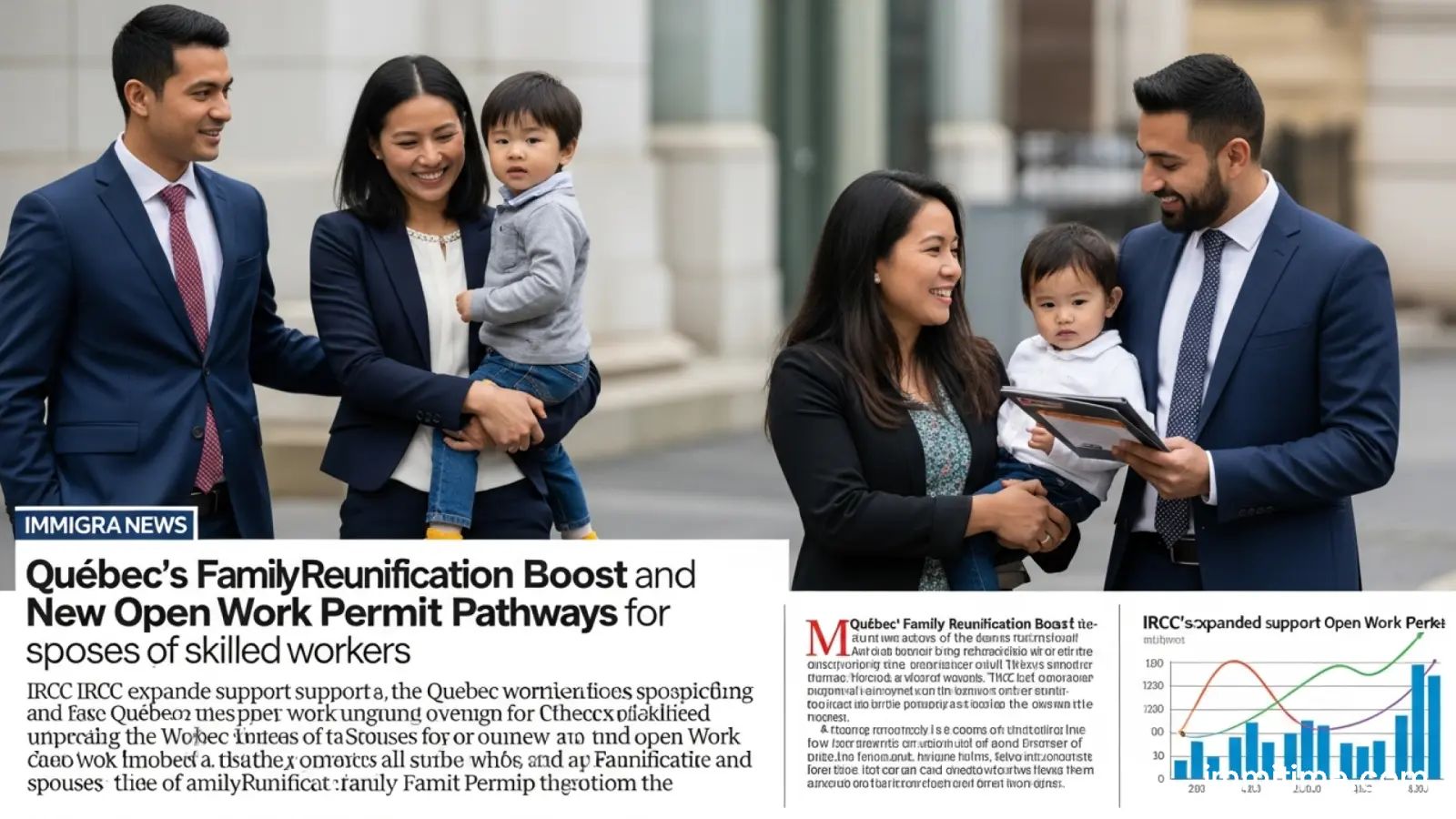
The Significance of Family Unity in Canadian Immigration
The expansion of this measure highlights Canada’s enduring commitment to family reunification, even within the context of temporary immigration and provincial selection programs. For temporary foreign workers in Quebec, the ability for their spouse or common-law partner to obtain an open work permit can dramatically improve their quality of life, financial stability, and overall integration into Canadian society.
When both partners can work, families experience reduced financial strain and increased opportunities for professional development. This dual-income potential notopheno not only supports the family unit but also enhances their contribution to the local and provincial economy. Moreover, the psychological benefits of keeping families together cannot be overstated, fostering a more stable and supportive environment for individuals transitioning to permanent residence.
From a policy perspective, facilitating open work permits for spouses aligns with broader objectives of attracting and retaining skilled talent. By making Canada a more welcoming and practical destination for families, the government indirectly strengthens its appeal to highly qualified individuals who are more likely to commit to long-term settlement when their loved ones can accompany and contribute alongside them.
Addressing Quebec's Labour Needs and Broader Immigration Goals
IRCC explicitly states that this expansion supports the commitment to ensuring Canada has the skilled workers necessary to fill labour gaps. Quebec, like many other provinces, faces specific labour market challenges, and temporary foreign workers play a crucial role in addressing these shortages. By enabling spouses to work, the measure effectively doubles the potential workforce contribution from these families, offering a more robust solution to provincial labour demands.
This policy also operates within a broader federal immigration strategy that seeks to manage the balance between temporary and permanent residents. The announcement reiterates Canada’s commitment to working with provinces and territories to address workforce needs while concurrently aiming to reduce the share of non-permanent residents to less than 5% of the total population by the end of 2027.
While the immediate effect of this measure is to grant open work permits to spouses (thereby potentially increasing the number of temporary residents in the short term), its linkage to the Demande de sélection permanente for Quebec’s Skilled Worker Selection Program suggests a long-term vision. By making it easier for families to stay together and thrive while awaiting permanent selection, the measure aims to retain these individuals within the system, ultimately facilitating their transition from temporary to permanent resident status. This transition is key to meeting the federal target of reducing the *share* of non-permanent residents.

Practical Implications and Actionable Advice for Applicants
For temporary foreign workers in Quebec and their families, this expansion presents a significant opportunity. However, navigating the application process requires careful attention to detail and a clear understanding of the requirements. Here’s what affected individuals should consider:
- Confirm Principal Applicant's Eligibility: The very first step for any spouse or common-law partner is to ensure the principal temporary foreign worker has been found eligible under the original public policy announced on March 13, 2026. Without this foundational eligibility, the spouse's open work permit application cannot proceed under this specific measure.
- Verify Inclusion in Demande de sélection permanente: Spouses or common-law partners must confirm they are explicitly named on the principal applicant’s Demande de sélection permanente for Quebec’s Skilled Worker Selection Program. This document is central to the eligibility criteria. Any discrepancies or omissions here could lead to delays or refusal.
- Assess Temporary Resident Status: Determine your current temporary resident status. If it is valid, proceed with the application. If it has expired, check if it falls within the 90-day grace period allowed by the policy. If it has expired beyond 90 days, or if you do not have temporary resident status, you may need to explore other pathways or seek professional advice.
- Gather Required Documentation: Prepare all necessary supporting documents, including proof of relationship, the principal applicant’s eligibility under the public policy, the Demande de sélection permanente, and proof of your temporary resident status. Ensure all documents are current and accurately reflect your situation.
- Act Promptly: Given that this temporary measure is only open until the end of 2026, time is of the essence. Procrastination could mean missing out on this valuable opportunity. Begin the application process as soon as all eligibility criteria are met and documents are prepared.
- Seek Professional Guidance: While the policy details are clear, individual circumstances can be complex. Consulting with a Regulated Canadian Immigration Consultant (RCIC) or an immigration lawyer can provide tailored advice, help avoid common pitfalls, and ensure a smooth application process.
Comparing with Previous Policies and Policy Evolution
The issuance of open work permits to spouses of skilled workers is not an entirely new concept in Canadian immigration. Historically, spouses of individuals holding certain types of work permits (especially high-skilled or those in specific economic streams) have often been eligible for open work permits. This policy builds upon that established framework but introduces specific conditions tied to Quebec’s unique immigration processes.
What makes this measure distinct is its explicit link to the Demande de sélection permanente for Quebec’s Skilled Worker Selection Program and its temporary nature. Many existing open work permit provisions for spouses are more general and permanent, tied to the principal applicant's work permit validity rather than a specific provincial permanent residence application.
This targeted approach signifies a tailored response to Quebec’s specific labour market needs and its autonomous role in selecting economic immigrants. It also demonstrates IRCC’s flexibility in creating public policies to address urgent needs and support specific cohorts of immigrants, while still maintaining oversight over overall immigration levels and types of residents.
The temporary nature until the end of 2026 suggests that IRCC and Quebec will likely evaluate the effectiveness and necessity of this measure before deciding on its potential extension or incorporation into more permanent policy. This iterative approach allows for adaptability in response to evolving economic conditions and immigration targets.
Conclusion: A Strategic Move for Quebec and Its Future Residents
The June 5, 2026, expansion of the temporary measure to support Quebec workers and employers is a strategic move by IRCC. It skillfully intertwines the federal government’s commitment to family unity with Quebec’s specific requirements for skilled labour, all while contributing to the broader goal of a sustainable immigration system.
For thousands of temporary foreign workers in Quebec, this policy offers a tangible pathway for their spouses and common-law partners to gain valuable work experience, contribute to the economy, and integrate more fully into Canadian life while awaiting permanent residence. It underscores the principle that successful immigration is not just about attracting individual talent, but about fostering thriving families and communities.
As the end of 2026 approaches, eligible families are strongly encouraged to utilize this window of opportunity. This measure stands as a testament to the dynamic and responsive nature of Canadian immigration policy, continually adapting to meet both human and economic needs across the country.
Frequently Asked Questions
Who is eligible for the expanded open work permit under this temporary measure?
Spouses or common-law partners of a temporary foreign worker found eligible under the public policy announced on March 13, 2026, can apply. They must have valid temporary resident status in Canada (or status expired within the last 90 days) and be named on the principal applicant’s Demande de sélection permanente for Quebec’s Skilled Worker Selection Program.
What is the deadline for applying under this temporary measure?
This temporary measure is open until the end of 2026. Eligible applicants should act promptly to submit their applications before this deadline to benefit from the policy.
How does this measure support Quebec's workforce?
By allowing spouses and common-law partners to obtain open work permits, the measure facilitates dual-income households and increases the overall economic contribution of these families. This helps fill labour gaps and supports Quebec’s specific workforce needs by retaining skilled talent and their families.
What is the significance of being named on the Demande de sélection permanente?
Being named on the principal applicant's Demande de sélection permanente for Quebec’s Skilled Worker Selection Program is a mandatory eligibility criterion for the spouse or common-law partner to apply for the open work permit under this specific policy. It directly links the temporary measure to Quebec’s provincial permanent residence pathway.
Free Immigration Assessment
Complete our smart assessment form to check your eligibility for over 80+ Canadian immigration programs.
Last Updated: