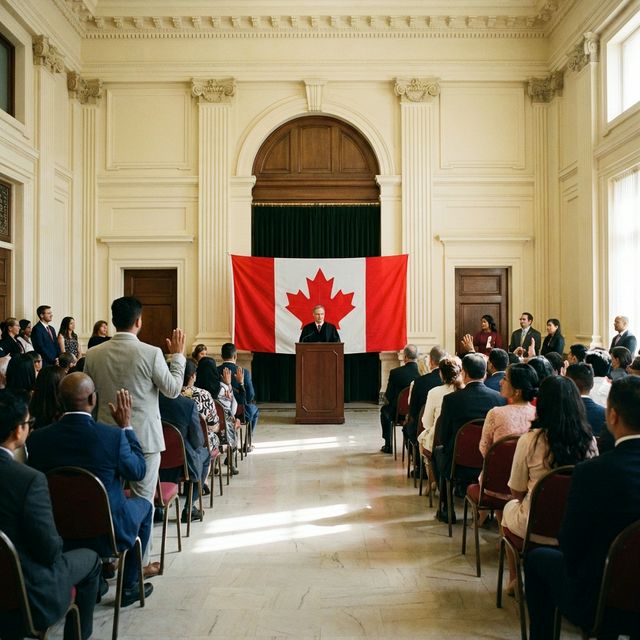
Becoming a Canadian citizen is a profound milestone, marking the culmination of a significant immigration journey and the beginning of a new chapter as a full member of the Canadian family. At the heart of this transition lies the Citizenship Ceremony and the Oath of Citizenship. This isn't just a formality; it's a deeply symbolic event where individuals formally commit to Canada and embrace the rights, responsibilities, and privileges that come with citizenship.
The Citizenship Ceremony is a formal legal proceeding presided over by a Citizenship Judge or a presiding official appointed by Immigration, Refugees and Citizenship Canada (IRCC). It serves as the final step in the citizenship application process. During this ceremony, applicants take the Oath of Citizenship, publicly affirming their allegiance to His Majesty the King of Canada, and promising to uphold Canadian laws and fulfill their duties as citizens. This oath is a solemn pledge, symbolizing a commitment to Canada's democratic values, its diverse society, and its rich heritage.
For many, the ceremony is an emotional and unforgettable experience, representing years of hard work, perseverance, and dreams realized. It brings together people from all walks of life, united by their shared commitment to Canada. Whether conducted in person at a community hall, an IRCC office, or virtually via a secure online platform, the essence remains the same: a public declaration of belonging and a celebration of diversity and inclusion.
Beyond the symbolic gesture, receiving your Canadian Citizenship Certificate at the ceremony empowers you with the full spectrum of Canadian rights, including the right to vote, hold a Canadian passport, and run for political office. It solidifies your place in Canada, offering stability, security, and a deeper connection to the country you now call home. As Regulated Canadian Immigration Consultants (RCICs), we witness the transformative power of this moment regularly, and we understand its immense significance for our clients.
To participate in a Canadian Citizenship Ceremony and take the Oath of Citizenship, you must have successfully navigated the entire citizenship application process and received an invitation from Immigration, Refugees and Citizenship Canada (IRCC). It's important to understand that eligibility for the ceremony is contingent upon meeting all the prerequisites for Canadian citizenship itself.
Here are the general requirements and conditions that lead to an invitation to the ceremony:
- Approved Citizenship Application: You must have received a positive decision on your application for Canadian citizenship. This means IRCC has determined that you meet all the criteria, including residency requirements, language proficiency, knowledge of Canada, and have no outstanding prohibitions.
- Receipt of Invitation: IRCC will send you an official invitation to attend a citizenship ceremony. This invitation will specify the date, time, and location (or virtual platform details) of your scheduled ceremony. It is crucial to respond to this invitation and follow all instructions provided.
- Physical Presence in Canada: Generally, applicants must be physically present in Canada to attend their citizenship ceremony. While there are very rare exceptions for certain circumstances, the vast majority of ceremonies take place within Canada.
- No Outstanding Issues: Between the time your application is approved and the ceremony date, IRCC may conduct final checks. Any new criminal charges, changes in your immigration status, or other significant developments could potentially delay or even revoke your invitation.
- Minors (Under 18): Children under 18 years of age applying for citizenship typically attend the ceremony with their parent(s) or legal guardian(s) who are also becoming citizens or are already Canadian citizens. Minors aged 14 and older are generally required to take the Oath of Citizenship, while those under 14 are not, though they may attend.
- Understanding the Oath: While there isn't a separate language test at the ceremony, your ability to understand and participate in the ceremony, including taking the Oath in English or French, is assumed based on your prior language proficiency assessment during the application process.
- Valid Identification: You will be required to present valid identification at the ceremony, as specified in your invitation. This typically includes your Permanent Resident (PR) card and other government-issued photo identification.
- No Renunciation Requirement: Canada permits dual citizenship. You are generally not required to renounce your previous citizenship to become a Canadian citizen, unless your country of origin requires it.
Restrictions and Important Considerations:
- Failure to Attend: If you cannot attend your scheduled ceremony, you must inform IRCC immediately. Failure to do so without a valid reason may result in your application being closed, requiring you to reapply.
- Misrepresentation: Any form of misrepresentation or fraud discovered at any stage, even after your application approval, can lead to your invitation being revoked and potentially future immigration consequences.
- Prohibitions: If you become subject to any citizenship prohibitions (e.g., serious criminal charges or convictions) after your application approval but before the ceremony, your invitation will be withdrawn.
Ensuring all your information remains current with IRCC and promptly addressing any requests for additional documentation or clarification is vital to avoid delays and ensure a smooth transition to citizenship.
The journey to the Citizenship Ceremony is the final stretch after a comprehensive application process. Here’s a detailed step-by-step guide on what to expect leading up to and during your Oath of Citizenship:
-
Citizenship Application Submission & Processing:
- You first submit your complete Canadian citizenship application to IRCC, including all required forms, documents, and fees.
- IRCC processes your application, which includes background checks, security checks, residency calculation, language proficiency assessment, and a knowledge test (if applicable).
- You may be asked to attend an interview with a citizenship official to verify information or clarify aspects of your application.
-
Application Approval (Decision Made):
- Once IRCC determines you meet all eligibility requirements, your application will be approved. You will typically receive notification of this decision. This is a significant milestone!
-
Invitation to Ceremony:
- After approval, IRCC will send you an official "Invitation to a Citizenship Ceremony." This invitation will specify whether the ceremony is in-person or virtual, along with the exact date, time, and location/link.
- Invitations are usually sent by email, but can also be sent by mail. Ensure your contact information with IRCC is up-to-date.
- Crucial: Read the invitation carefully for specific instructions, including documents to bring and any pre-ceremony requirements.
-
Pre-Ceremony Preparation:
- Review Instructions: Familiarize yourself with all instructions in your invitation.
- Documents: Gather all required documents. This typically includes your Permanent Resident (PR) card, two pieces of valid personal identification (one with a photo), and any foreign travel documents or passports you hold. For virtual ceremonies, you'll need to have these ready for verification.
- The Oath: Review the Oath of Citizenship. You will be asked to recite it in English or French.
- National Anthem: Learn or refresh your memory of "O Canada," as it is typically sung at the ceremony.
- Virtual Ceremony Specifics: If your ceremony is virtual, ensure you have a stable internet connection, a quiet space, and a device with a camera and microphone. You may be asked to do a technical check prior to the ceremony.
-
Attending the Ceremony (In-Person or Virtual):
- Arrival/Login: Arrive at the specified location or log in to the virtual platform well in advance of the start time.
- Registration/Check-in:
- In-Person: You will register, present your required documents for verification, and surrender your PR card.
- Virtual: You will join a secure online meeting. A citizenship official will verify your identity by asking you to show your documents to the camera. You will be instructed on how to cut your PR card in half (rendering it invalid) during the ceremony.
- Seating/Waiting: You will be directed to your seat (in-person) or wait in a virtual waiting room until the ceremony begins.
-
The Ceremony Itself:
- Welcome: The ceremony typically begins with opening remarks from the Citizenship Judge or presiding official, acknowledging the significance of the event and welcoming new citizens.
- Video/Presentation: There may be a short video about Canada, its values, and the responsibilities of citizenship.
- Taking the Oath: The highlight of the ceremony. The Citizenship Judge will lead all applicants in reciting the Oath of Citizenship in unison, in either English or French. You will be asked to raise your right hand.
- Singing the National Anthem: All participants will then sing "O Canada."
- Remarks: The Judge or special guests may offer congratulatory remarks.
-
Receiving Your Citizenship Certificate:
- In-Person: You will be called forward, usually in small groups, to receive your official Canadian Citizenship Certificate from the Citizenship Judge or official. This is a moment often captured with photos.
- Virtual: After the oath, instructions will be given on how and when you will receive your certificate. It is typically mailed to you within a few weeks after the ceremony.
-
Post-Ceremony:
- Update Documents: Once you have your Citizenship Certificate, you can apply for a Canadian passport. You should also update other important identification documents, such as your provincial driver's license or health card, to reflect your new citizenship status.
- Exercise Rights: You are now a full Canadian citizen! You can register to vote, participate in elections, and fully engage in Canadian society.
This structured process ensures that every new citizen understands the solemn commitment they are making and is properly welcomed into the Canadian family.
Understanding the timelines and financial implications associated with becoming a Canadian citizen, particularly concerning the final ceremony and oath, is crucial for effective planning. As an RCIC, we help manage expectations regarding these critical aspects.
Processing Times
It's important to distinguish between the processing time for the entire citizenship application and the waiting time for the ceremony invitation after your application has been approved.
-
Overall Citizenship Application Processing Time:
- IRCC regularly updates its processing times on its official website. These times can vary significantly based on the volume of applications, the complexity of individual cases, and global events.
- As of recent updates, the processing time for a Canadian citizenship application for most adults is typically 12 to 24 months, but this is an estimate and can fluctuate. It is vital to check the IRCC website for the most current information.
- This period covers everything from application submission to the final decision and readiness for the ceremony.
-
Waiting for Ceremony Invitation (After Approval):
- Once your application has been approved, there is usually an additional waiting period before you receive an invitation to a ceremony. This can range from a few weeks to several months.
- The scheduling depends on the availability of Citizenship Judges, the capacity of IRCC to organize ceremonies (both in-person and virtual), and the number of approved applicants in your region.
- Virtual ceremonies, which became more prevalent during the pandemic, have helped to streamline the process, but backlogs can still occur.
- IRCC aims to schedule ceremonies as efficiently as possible, but specific dates cannot be guaranteed immediately upon approval.
Costs
The good news is that the Citizenship Ceremony itself is free of charge. There are no additional fees to attend the ceremony or to take the Oath of Citizenship.
However, there are associated government fees for the citizenship application that must be paid upfront when you submit your application:
- Application Fee for Adults (18 years and older):
- Right of Citizenship Fee: $530 CAD
- Processing Fee: $100 CAD
- Total for Adults: $630 CAD
- Application Fee for Minors (under 18 years old):
- Processing Fee: $100 CAD
- Total for Minors: $100 CAD (The Right of Citizenship Fee does not apply to minors.)
Other Potential Costs (Indirect):
- Travel Costs: If your ceremony is in-person and requires travel to a different city or a distant venue, you will be responsible for your transportation, accommodation, and any related expenses.
- New Passport Application: After becoming a citizen, you will likely want to apply for a Canadian passport. This is a separate application with its own fees (e.g., typically around $120-$160 for a standard 5-year or 10-year adult passport, plus photo costs).
- Immigration Consultant Fees: If you choose to retain the services of a Regulated Canadian Immigration Consultant (RCIC) to assist with your citizenship application, their professional fees will be an additional cost. While not mandatory, an RCIC can provide invaluable guidance, ensure accuracy, and help navigate complexities, potentially saving you time and stress.
It's crucial to budget for these associated costs alongside the primary application fee. For the most accurate and up-to-date information on IRCC processing times and fees, always refer to the official IRCC website or consult with a qualified RCIC.
Here are answers to some of the most common questions our clients ask about the Canadian Citizenship Ceremony and Oath:
Q1: What documents do I need to bring to my citizenship ceremony?
A1: The specific documents required will be clearly outlined in your "Invitation to a Citizenship Ceremony." However, typically, you must bring the following:
- Your Permanent Resident (PR) card. This will be surrendered at the ceremony (or cut in half if virtual).
- Two (2) pieces of valid personal identification, at least one of which must have your photograph and signature (e.g., driver's license, provincial health card, foreign passport).
- The original invitation letter from IRCC.
- All foreign travel documents and passports you possess.
- Any other documents specifically requested by IRCC in your invitation. For virtual ceremonies, you'll need to have these documents readily available to show to the camera for verification.
Q2: Can I bring guests to my citizenship ceremony?
A2: Yes, generally you are permitted to bring guests to your citizenship ceremony to share in this special moment.
- In-person ceremonies: Most in-person ceremonies allow a limited number of guests (e.g., 2-4 guests per applicant) due to venue capacity. The invitation will specify any guest limits. It's advisable to confirm with IRCC if you plan to bring a larger group.
- Virtual ceremonies: For virtual ceremonies, your family and friends can often join the online meeting as guests, as long as they respect the decorum of the event. The invitation will provide specific instructions or links for guests. It's always best to check your specific invitation for guest policies, as they can vary.
Q3: What happens if I cannot attend my scheduled citizenship ceremony?
A3: It is absolutely critical that you contact IRCC immediately if you are unable to attend your scheduled ceremony.
- Valid Reasons: If you have a legitimate reason (e.g., medical emergency, unavoidable travel, critical family event), IRCC may reschedule your ceremony. You may need to provide supporting documentation.
- Consequences of No-Show: If you fail to attend without notifying IRCC, or if you do not have a valid reason, your citizenship application may be considered abandoned and could be closed. If this happens, you would have to submit a new application and pay the fees again, restarting the entire process.
- Rescheduling: Once you inform IRCC, they will provide instructions on how to request a new date. There might be a waiting period for a rescheduled ceremony.
Q4: Do I have to renounce my previous citizenship to become a Canadian citizen?
A4: No, Canada allows dual citizenship. This means you generally do not have to give up your previous citizenship when you become a Canadian citizen. Canada recognizes that many individuals hold citizenship in more than one country.
- Country of Origin's Laws: While Canada permits dual citizenship, your country of origin may have its own laws regarding multiple nationalities. Some countries may automatically revoke your citizenship if you acquire another. It is your responsibility to understand the laws of your home country regarding dual citizenship if this is a concern for you.
- No Requirement from IRCC: IRCC will not ask you to provide proof of renunciation of your prior citizenship as a condition for becoming a Canadian citizen.
Q5: What happens immediately after the ceremony, and what should I do next?
A5: After taking the Oath and receiving your Citizenship Certificate, you are officially a Canadian citizen! Here's what typically happens next:
- Certificate in Hand: For in-person ceremonies, you'll receive your physical Citizenship Certificate. For virtual ceremonies, it will be mailed to you within a few weeks. This certificate is your official proof of Canadian citizenship.
- Apply for a Canadian Passport: This is often the first step for new citizens. You can use your Citizenship Certificate to apply for a Canadian passport, which is a highly recognized and respected travel document worldwide.
- Update Other Identification: You should update your provincial driver's license, health card, and any other government-issued identification to reflect your Canadian citizenship and updated status.
- Register to Vote: As a Canadian citizen, you have the right to vote in federal, provincial/territorial, and municipal elections. Register with Elections Canada to ensure you can exercise this fundamental right.
- Embrace Your Rights & Responsibilities: Beyond practical steps, you are now entitled to all the rights and bound by all the responsibilities of a Canadian citizen, including upholding Canadian laws and contributing to your community.
As an RCIC, we can guide you through these post-ceremony steps and assist with your Canadian passport application.