Canadian by Blood, Not by Choice: How a New Law Unlocks Citizenship for Millions with Distant Ancestry
A major change to Canada's Citizenship Act has removed generational limits, potentially making millions with distant Canadian ancestry eligible for a passport.

Free Immigration Assessment
Complete our smart assessment form to check your eligibility for over 80+ Canadian immigration programs.
The Two Paths to Being Canadian: By Heart and By Heritage
When music icon Elton John recently accepted the prestigious Glenn Gould Prize in Toronto, he declared himself “Canadian.” This statement, born from a three-decade partnership with his Canadian husband, filmmaker David Furnish, and raising their two Canadian children, resonates with a deep, personal connection. To his Toronto fans and many across the country, John is indeed Canadian by choice, his life intricately woven into the nation's fabric. He told the award ceremony crowd, “Canada is part of my life and is embedded in my soul. I have a family here.”
Yet, a stark contrast exists between this heartfelt affiliation and the rigid lines of Canadian citizenship law. While Sir Elton John, despite his profound ties, holds no legal claim to Canadian status, a recent and monumental policy shift has granted this right to millions around the globe, many of whom possess a far more tenuous connection to the country. This change hinges not on choice, love, or life experience, but on the simple, powerful fact of bloodline.
In a move that redefines the scope of jus sanguinis (right of blood) in Canada, the government has retroactively expanded eligibility for citizenship by descent. As we will explore, this has profound implications for individuals, families, and the very concept of Canadian identity in a globalized world. It raises a fascinating question: who has a greater claim—the person who builds a Canadian life by choice, or the person who discovers a Canadian ancestor in a century-old document?
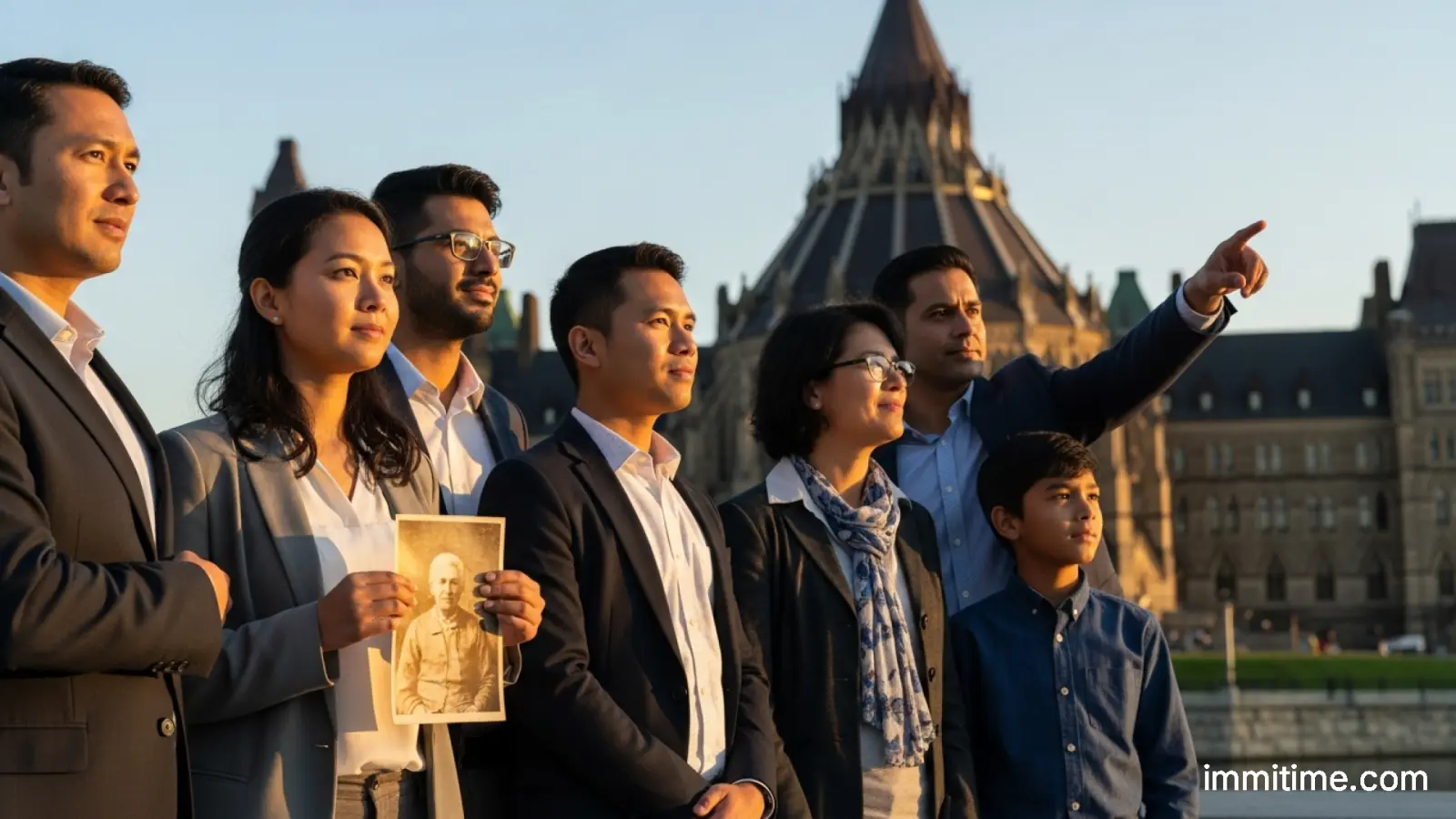
Understanding Bill C-3: The Removal of the Generational Limit
The core of this transformation lies in a legislative amendment that took effect under what is known as Bill C-3. The key change, which became law on December 15, 2025, was the elimination of the generational limit on citizenship by descent for individuals born before that date. Previously, the ability to pass on Canadian citizenship to children born abroad was often restricted to the first generation born outside Canada. This new provision effectively blows those limitations away.
Under the current Citizenship Act, anyone born before December 15, 2025, who can prove an unbroken line of ancestry to a single Canadian-born relative, is now potentially eligible for Canadian citizenship. The number of generations separating the applicant from their Canadian ancestor is no longer a barrier. This means that a person whose great-great-grandparent was born in Canada and left the country generations ago may now have a stronger legal right to citizenship than someone like Elton John, who has spent decades building a Canadian family.
This single legislative stroke has opened the door to a vast, previously ineligible population. The law does not require any prior connection to Canada, knowledge of the country, or intent to reside there. If the genealogical proof exists, the right to citizenship may already be yours—it simply needs to be formally recognized by Immigration, Refugees and Citizenship Canada (IRCC).
The Global Impact: Who Are These Potential New Canadians?
The implications of this policy are global, but they are particularly pronounced in the United States. Historical migration patterns have created a massive pool of potential applicants south of the border. An estimated 3 million Americans are believed to have French-Canadian ancestry. This is largely a result of the mass migration between 1840 and 1930, when nearly 900,000 Quebecers moved to New England in search of economic opportunity. For generations, their descendants have lived entirely in the United States, yet this ancestral link has now become a direct pathway to a Canadian passport.
Another significant group mentioned are the Cajuns in Louisiana, whose heritage can be traced back to the Acadian expulsion from Nova Scotia in the 18th century. Many more across the U.S. and, indeed, the world, may have Canadian roots without even realizing it. Clues can often be found in plain sight:
- Surnames: A French or anglicized surname could point to Quebecois or Acadian heritage.
- Family History: A known family history of residing in regions like New England or Louisiana can be a strong indicator.
The further one is able to trace their family tree, the higher the likelihood of discovering a Canadian ancestor. This policy effectively turns genealogy from a hobby into a potential life-changing legal discovery for millions.

The Tangible Benefits: What Canadian Citizenship Offers
For those who successfully prove their ancestry, the rewards are significant and concrete. Acquiring Canadian citizenship is not merely a symbolic act; it confers a powerful set of rights and privileges.
Unconditional Rights in Canada
A Canadian citizen holds the absolute and unconditional right to enter, live, and work anywhere in Canada at any time. There are no visas, no work permits, and no time limits on their stay. This provides unparalleled mobility and opportunity for personal and professional life within Canada.
Global Mobility and Dual Citizenship
The Canadian passport is one of the most powerful travel documents in the world. It currently ranks seventh on the Henley Passport Index, providing visa-free access to 182 destinations. For citizens of many countries, including the United States and the United Kingdom, Canada fully recognizes dual citizenship. This means an American or Brit who claims Canadian citizenship by descent can hold both passports and enjoy the benefits of each. Obtaining Canadian citizenship has no effect on their existing U.S. or UK citizenship.
Favourable Tax Position
A significant concern for many considering second citizenship is taxation. Canada offers a distinct advantage here, especially for non-residents. Unlike the United States, which taxes its citizens on their worldwide income regardless of where they live, Canada applies no such worldwide tax on its non-resident citizens. Tax obligations are generally based on residency, not citizenship, making it an attractive option for those who may not plan to live in Canada full-time.
It is crucial, however, for citizens of other countries to confirm their home country's stance on dual nationality before applying, as not all nations permit it.
A Practical Guide: How to Claim Your Canadian Citizenship
For those who suspect they may be eligible, the process involves two main stages: proving your lineage and applying for official status. Here is a breakdown of the steps involved.
Step 1: Genealogical Research and Document Collection
This is the foundational and often most challenging step. You must identify at least one Canadian-born ancestor and then gather the official documents to prove your direct, unbroken descent from them. The core documents required by IRCC include:
- Birth certificates for each generation
- Marriage certificates for each generation
- Baptismal records (often used as a substitute for older birth records)
Each document must clearly link one generation to the next, creating a complete paper trail from your Canadian ancestor to you.
Step 2: Apply for a Proof of Citizenship Certificate
Once you have your documentary evidence, you can submit an application for a proof of citizenship certificate to IRCC. This is the official document that legally recognizes your status as a Canadian citizen. According to current estimates, processing this application takes approximately 12 months.
Step 3: Apply for a Canadian Passport
With your citizenship certificate in hand, you are then eligible to apply for a Canadian passport. This process is much faster, with current processing times estimated at 10 to 20 business days for standard applications submitted within Canada.

Conclusion: A Redefined Connection
Elton John's connection to Canada is built on decades of love, family, and personal history—a bond that is undeniably profound. For millions of others, the connection is now being discovered through ancestral records—a grandparent from Quebec, a great-grandmother from Nova Scotia, a distant relative whose journey took them away from Canada generations ago.
Thanks to this pivotal change in Canadian law, that ancestral connection now comes with a passport. It challenges us to consider the different ways one can be 'Canadian' and highlights a unique intersection of history, law, and personal identity. While one man claims Canada in his soul, millions may soon be able to claim it on paper, forever changing their lives and their relationship with a country they may have never known was theirs to begin with.
Frequently Asked Questions
What is the biggest change from the new law on citizenship by descent?
The new law, effective December 15, 2025, for those born before that date, eliminates the generational limit for inheriting Canadian citizenship. This means you can be eligible even if your Canadian ancestor lived many generations ago.
What kind of documents do I need to apply for citizenship by descent?
You need official documents that prove an unbroken line of descent from a Canadian-born ancestor. The core documents are birth certificates, marriage certificates, and baptismal records for each generation connecting you to that ancestor.
Will claiming Canadian citizenship affect my current U.S. or U.K. citizenship?
No. For citizens of the United States and the United Kingdom, obtaining Canadian citizenship has no effect on your existing citizenship as both countries fully recognize dual nationality. You will not have to renounce your current passport.
How long does the entire process to get a Canadian passport take?
The process has two main steps. First, applying for a proof of citizenship certificate currently takes approximately 12 months. After you receive the certificate, applying for a Canadian passport takes an additional 10 to 20 business days.
Free Immigration Assessment
Complete our smart assessment form to check your eligibility for over 80+ Canadian immigration programs.
Last Updated: