
The Great Canadian Lineage Rush: New Citizenship Law Overwhelms Archives, Attracts Millions of Americans
A landmark change to Canada's citizenship law has allowed millions of Americans to claim ancestry, triggering an archival crisis and a rush for a 'back-up plan' passport.

Free Immigration Assessment
Complete our smart assessment form to check your eligibility for over 80+ Canadian immigration programs.
A Landmark Policy Shift Unleashes a Genealogical Gold Rush
In a move that has reshaped the landscape of Canadian citizenship, the federal government has enacted a profound change to its laws of descent. By eliminating the long-standing first-generation limit, Canada has retroactively opened the door to citizenship for millions of individuals in the United States and beyond. The new legislation grants the right to Canadian citizenship to any person born prior to December 15, 2025, who can prove they have at least one Canadian ancestor, regardless of how many generations have passed. What was intended as a policy of inclusion has inadvertently triggered an administrative tsunami, with provincial archives now finding themselves at the epicenter of an unprecedented surge in demand.
This policy analysis will delve into the far-reaching consequences of this legislative change. We will examine the staggering operational pressures on Canada's archival institutions, explore the deep historical migrations that made millions of Americans eligible, analyze the motivations driving this new wave of applicants, and provide practical guidance for those navigating this complex and backlogged process. For many Americans, the discovery of a Canadian great-great-grandparent has suddenly become the key to a second passport and a future of expanded opportunities.
The Archival Gridlock: A System Under Siege
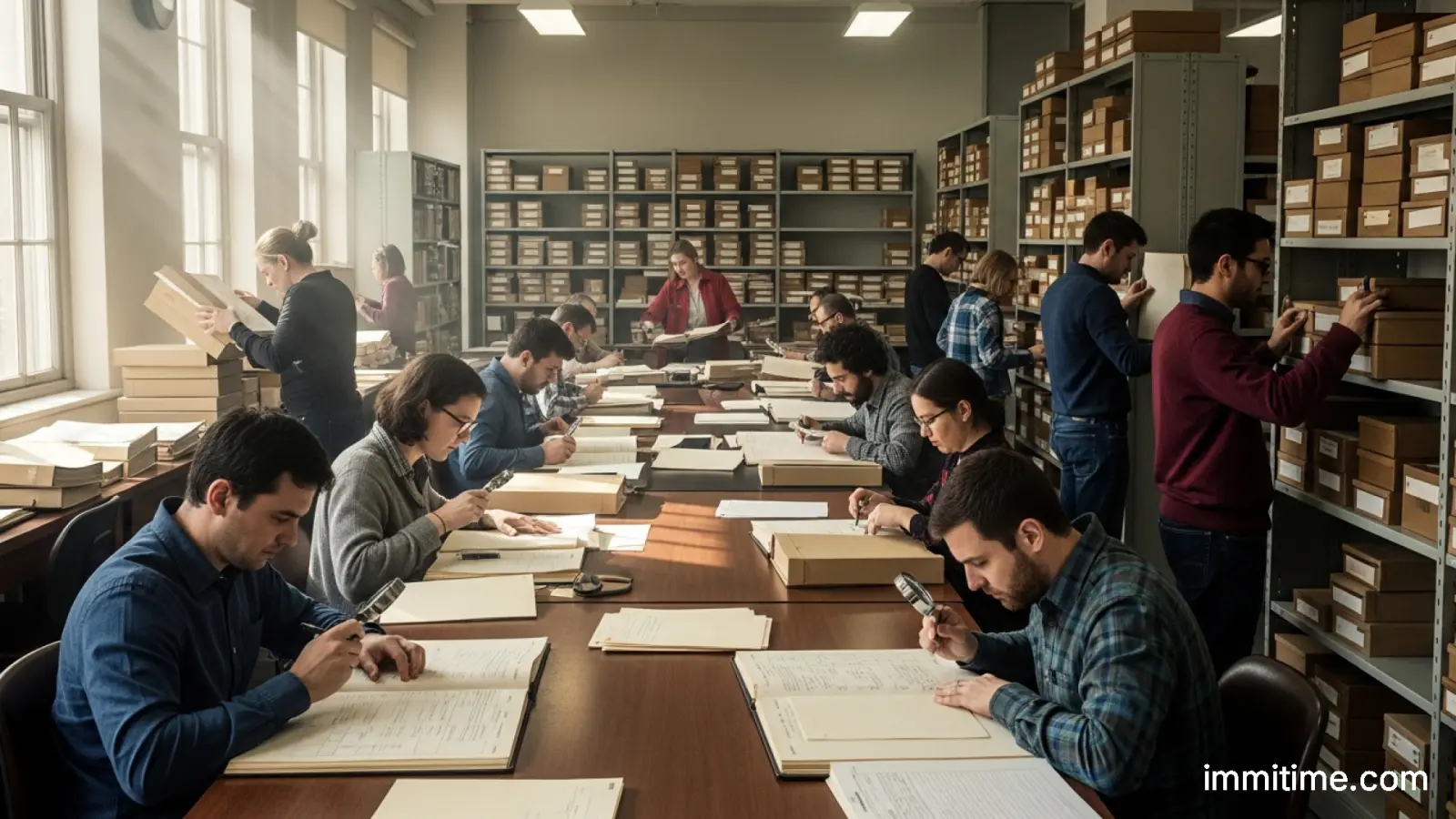
The path to a Canadian passport for these newly eligible individuals is not a simple one. Before applying for a passport, an applicant must first secure a proof of Canadian citizenship certificate. This critical step requires meticulous genealogical detective work and, most importantly, official vital records—birth certificates, marriage licenses, and baptismal records—that irrefutably link the applicant to their Canadian ancestor. The keepers of these records, Canada's provincial archives, are now facing a deluge of requests that has strained their resources to the breaking point.
Quebec: Echoes of the Great Hemorrhage
The most dramatic impact has been felt in Quebec. The Bibliothèque et Archives nationales du Québec (BAnQ) has reported a staggering 3,000% increase in requests. This colossal surge is a direct consequence of a major historical demographic shift known as the "Great Hemorrhage." Between 1840 and 1930, hundreds of thousands of French Canadians left Quebec for factory jobs and economic opportunity in New England. Generations later, their American descendants are now looking north again, seeking the documents that prove their heritage.
The Maritimes: A Legacy of Displacement
The Atlantic provinces are experiencing a similar, historically-rooted phenomenon. The archives in New Brunswick, Nova Scotia, and Prince Edward Island are contending with a wave of requests stemming from the 18th-century displacement of the Acadians. Forcibly expelled by the British beginning in 1755, many of these French-speaking settlers eventually found a new home in Louisiana, becoming the ancestors of today's Cajun population. Now, their descendants are tracing those lines of forced migration back to Eastern Canada.
- Nova Scotia: As reported by CBC News in March, the Nova Scotia Archives witnessed 10 times more requests in January and February than in the same period of the previous year. By March, its backlog had grown to approximately 600, with 270 new requests added. The figures for early 2026 are even more stark: from January to March of 2026, the archives received 1,354 requests, a massive leap from the 262 requests received during the entire calendar year of 2024.
- New Brunswick: The Provincial Archives of New Brunswick is currently grappling with a backlog of over 1,000 requests. According to archivist Joanna Aiton Kerr, the surge began in December and shows no signs of slowing, with an additional 400 citizenship-related requests arriving each month. The archive currently advises that it may take six to eight weeks merely to respond to an initial inquiry.
- Prince Edward Island: The situation is mirrored on a smaller scale at PEI’s Public Archives and Records Office, which has seen a 143 per cent increase in requests this year. The volume is so high that the office has implemented an automatic email response stating it cannot provide a timeline for when orders will be completed.
The American Dream, Reimagined: Why Apply Now?
The data reveals a fascinating trend: Americans are overwhelmingly the primary group pursuing this opportunity. Applications from the United States outnumber those from the United Kingdom, the second-highest source country, by a factor of ten. Yet, for many of these applicants, this is not about immediate relocation. Instead, Canadian citizenship has become a highly sought-after "back-up plan"—an insurance policy in an uncertain world.
The appeal is rooted in a pragmatic calculation of benefits with virtually no drawbacks. Since both Canada and the United States permit dual citizenship, Americans can gain a second nationality without relinquishing their first. The advantages are significant:
- Taxation: A key driver is Canada's tax policy. Unlike the United States, which taxes its citizens on their worldwide income regardless of where they reside, Canada does not. For U.S. citizens living abroad, this is a major point of financial and administrative friction. Obtaining Canadian citizenship does not subject a U.S. resident to any new Canadian tax obligations.
- Rights and Mobility: As dual citizens, these individuals gain the full rights and privileges of being Canadian. This includes the right to enter, live, and work in Canada at any time, providing a powerful layer of personal and professional security.
- Passport Power: The Canadian passport consistently ranks among the world's best. According to the Henley Passport Index cited in the source material, the Canadian passport currently ranks higher than its U.S. counterpart, offering greater visa-free access to countries around the globe.
For thousands of Americans, the process of tracing their roots has become more than a hobby; it's a strategic life decision. The discovery of a Canadian ancestor is no longer just a piece of family trivia but a tangible asset with real-world value.

A Practical Guide for Prospective Applicants
For those Americans just discovering their potential eligibility, it is crucial to approach the process with a clear understanding of the steps and, most importantly, a great deal of patience. The current archival gridlock means that what was once a relatively straightforward process of ordering documents now requires strategic planning and managed expectations.
Step 1: The Genealogical Deep Dive
Before you can even contact an archive, you must do your homework. Your first task is to identify the Canadian ancestor who forms the basis of your claim. This involves tracing your family tree back through generations, identifying names, dates of birth, marriage, and death, and the specific towns or parishes where they lived in Canada. Online genealogy resources, family records, and talking to older relatives are essential starting points.
Step 2: The Archival Request and The Long Wait
Once you have identified the ancestor and the likely location of their records, you can contact the relevant provincial archive. Be prepared for significant delays. As the data shows, wait times of several months for a response, let alone the documents themselves, are now the norm. When you do make a request, be as specific as possible, providing all the names, dates, and locations you have gathered. Vague requests are more likely to be delayed or rejected.
Step 3: The Official Citizenship Application
Only after you have received the certified copies of the necessary vital records can you begin the formal application for a proof of Canadian citizenship certificate with Immigration, Refugees and Citizenship Canada (IRCC). This is a separate process from the archival request and has its own processing times. Once your citizenship is officially recognized and you have your certificate, you can then apply for a Canadian passport.
Given the unprecedented volume and the resulting delays, anyone embarking on this journey should understand that this is a marathon, not a sprint. The demand is far from abating, and the system is likely to remain under pressure for the foreseeable future.

Conclusion: A New Chapter in Canadian Identity
The removal of the first-generation limit on citizenship by descent is a landmark policy that speaks to an inclusive and expansive vision of Canadian identity. However, it has also served as a powerful stress test, revealing the fragility of public systems when faced with an exponential and unforeseen demand. The archival backlogs across the country are not merely an administrative issue; they are the physical manifestation of historical narratives, connecting the migrations of the 18th and 19th centuries to the geopolitical and personal anxieties of the 21st.
As Canada welcomes a new, historically-connected cohort of citizens, it must also invest in the infrastructure needed to process them. For the millions of Americans now looking north, the path to citizenship is paved with historical documents, bureaucratic hurdles, and the promise of a future anchored in the security of a second home.
Frequently Asked Questions
Who is eligible for Canadian citizenship under this new law?
Under the new legislation, anyone born prior to December 15, 2025, who has a Canadian ancestor is eligible to apply for citizenship, regardless of how many generations ago that ancestor lived in Canada.
Why are Canadian provincial archives experiencing such long delays?
The archives are overwhelmed by a massive surge in requests for vital records from citizenship applicants. For example, Quebec's national archive saw a 3,000% increase, and New Brunswick has a backlog of over 1,000 requests, with 400 new ones coming in monthly.
What is the first step to apply for Canadian citizenship by descent?
The first step is not applying to the immigration department, but rather gathering proof of your lineage. You must obtain official documents, such as birth or marriage certificates from provincial archives, to prove your connection to a Canadian ancestor before you can apply for a citizenship certificate.
What are the main benefits for an American claiming Canadian citizenship?
Americans can hold dual citizenship, granting them the right to live and work in Canada at will. Additionally, Canada does not impose a worldwide tax on non-resident citizens (unlike the U.S.), and the Canadian passport currently ranks higher than the U.S. passport for visa-free travel.
Free Immigration Assessment
Complete our smart assessment form to check your eligibility for over 80+ Canadian immigration programs.
Last Updated: